Chris Hemsworth THOR 2 THE DARK WORLD

Chris Hemsworth THOR 2 THE DARK WORLD


With Chris Hemsworth’s new movie Rush due to hit theatres October 3, guys all over the world are wondering how Chris Hemsworth managed to get ripped and muscled for the role. After all, if Chris was going to play the role of British playboy James Hunt, he had to look the part. Some of the questions being asked about Hemsworth’s Rush workout include:


  • What was the Chris Hemsworth workout for Rush?
  • Is the Rush workout really that different to the Thor workout?
  • What was Chris’ exact Rush workout routine and diet?
  • How can I look like Chris with an easy and effective workout ?
This post will cover the exact strategies Chris used in preparation for his role as James Hunt in Rush, which is perfect for getting a lean and muscular build.

Background to the Chris Hemsworth workout for Rush

Before examining the Rush workout, it’s important to understand that Chris always commits 100% to his roles. He proved this with his role as Thor in the film Thor and the Avengers. The world saw how he transformed his body from a thin Aussie surfer, to lean, muscular and shredded in under 3 months. In case you haven’t seen this clip yet, Chris Hemsworth talks about the Chris Hemsworth workout for Thor below:


For Thor, Chris stacked on 20 lbs of muscle in under 3 months. So as you can see, Chris is no stranger to effective workouts to gain lean muscle fast.

The Chris Hemsworth Rush Workout Phase 1: Bulking Up

While the Rush workout was similar to the Thor workout, Chris’s trainer made sure the actor’s Rush workout was more refined to avoid getting too big for the role.
Like the Thor workout, Chris relied on compound exercises to build muscle fast. The advantage of compound exercises are that they are great for building muscle and for getting a muscled physique fast. The 3 most common compound exercises are:
    1. Squats.
  1. Deadlifts.
  2. Bench press.
While compound training is great for bulking up and building muscle, if you focus only on these, it creates a bulky, hour-glass figure, which as a guy you don’t want. Instead, the most important strategy to achieving the look of Chris Hemsworth is to get lean enough to the point where you have no loose skin so your abs are clearly visible, and you’re looking cut up and ripped.


The Chris Hemsworth Rush Workout Phase 2: The Shrink Wrap Effect

The second part of the Chris Hemsworth workout is the use of a common Hollywood technique called the ‘Shrink Wrap Effect’. Other stars that have used this technique include Taylor Lautner (Twilight: New Moon) and Brad Pitt.
The Shrink Wrap Effect works by tightening your skin around your muscles. Here’s a video explaining the Shrink Wrap Effect:

This is one of those rare Hollywood techniques that works.
To achieve the Shrink Wrap Effect, Chris focussed on reducing his rep range, resulting in fast tightening of the skin around his muscles, particularly his abs and arms, which you see in Rush. Chris’ trainer insisted on using the Shrink Wrap Effect because the technique is known to start showing lean, ripped abs in a small amount of time.
So if you’re wanting to look like Chris in Rush, what you want to do is lose body fat by going for smaller rep ranges. After this, you want to focus on sarcoplasmic growth.
So get pumped, by following the exact Chris Hemsworth workout as explained you too will be able to get the ripped, muscular build Chris achieved, and best of all, in under three months.

A Great Person - A Great Leader Nelson Mandela Passed Away


The passing of Mandela was at once thoroughly foretold and unexpectedly jarring, as people recalled his graceful leadership through what appeared to be intractable racial crisis in South Africa and his ability to embody hope for moral progress in a beleaguered and often-unjust world.

"We've lost our greatest son. Our nation has lost its greatest son. Our people have lost a father," South African President Jacob Zuma said in a televised address that aired around the world. "Although we knew that this day would come, nothing can diminish our sense of a profound and enduring loss."
Tributes began flooding in almost immediately for a man who was an iconic global symbol of struggle against injustice and of racial reconciliation.

A Great Person - A Great Leader Nelson Mandela Passed Away
 
Mr Mandela led South Africa's transition from white-minority rule in the 1990s, after 27 years in prison for his political activities.
He had been receiving intensive medical care at home for a lung infection after spending three months in hospital.
Announcing the news on South African national TV, President Jacob Zuma said Mr Mandela was at peace.
"Our nation has lost its greatest son," Mr Zuma said.
 

The man himself - president, Nobel laureate, inspiration to oppressed people worldwide - was always more complex than his super-heroic public image, as embodied in statues erected in so many capitals. He was long regarded as a terrorist by South Africa's government and its allies, and he openly embraced armed resistance as a revolutionary necessity before spending 27 years in prison.

But the Mandela being remembered was more the leader who walked free in 1990, forgave his captors and peacefully navigated his nation through what most observers - inside and outside South Africa - expected would be a civil war. The reality of multi-racial democracy has proved harder and far less equal than many expected when it arrived in 1994, but love for Mandela has never dimmed.

LDA Plans ‘Largest Housing Scheme’ LDA CITY LAHORE

The Lahore Development Authority (LDA) has planned the largest housing scheme of the metropolis on Ferozepur Road, namely the ‘LDA City’.
LDA Plans ‘Largest Housing Scheme’
LDA Lahore
According to details, the housing scheme would be launched on the basis of land sharing methodology between landowners and the LDA, on an area of approximately 5,000-acres. LDA has invited expressions of interest (EOI) and pre-qualification from urban planning consulting firms for planning and designing of the LDA City housing scheme.

Only the firms registered with the Pakistan Engineering Council and other relevant professional institutes could submit their EOI before September 16 to the Metropolitan Planning Department of the LDA. The project includes high-rise buildings and high-end modern commercial centres aiming to give a boost to the city’s economic life and provide a healthy lifestyle on reasonable prices.
The LDA City will be the largest housing scheme in the history of LDA. However, LDA would engage those investors, development partners and agents who would be responsible for transferring land to the LDA after purchasing it from landowners.
Meanwhile, LDA’s Town Planning Wing has also carried out an operation against the construction of illegal buildings in different areas of the Johar Town. The operation was conducted after the Town Planning Wing identified two buildings violating the LDA bylaws. In the Q-Block of Johar Town, the LDA staff demolished the illegally built second portion of the plot No 587-A. Another illegally constructed first floor of plot No 4 was bulldozed at the C2 Block of Johar Town. The buildings were constructed without the approval of the building construction plan and disregarding the laws of LDA.

Myth About Brain Read It

Myth About Brain
Myth About Brain
Have you been taught that you’re either creative, intuitive, and right brained or analytical, logical, and left brained? It’s actually a myth. While your brain’s hemispheres do function in different ways, those ways aren’t easily categorized. For instance, your left hemisphere processes details while overall shape recognition takes place in your right hemisphere. More importantly, no area of your brain ever works in isolation. Every thought and action relies on connections between multiple brain areas across the hemispheres. This doesn’t mean you can’t be more logical or creative — you just have your entire brain to thank!


Sufi Music- Peace Qawali Tour 2013 Presented By Aqua Safe

Sufi Music- Peace Qawali Tour 2013

Aqua Safe Presents Peace Qawali in the major cities of Pakistan and saying goodbye to 2013.

Organized by the Aqua Safe Foundation, Sponsored by the US Embassy

Mian Salli's Haveli

US Ambassador Richard G Olson Residence in Islamabad

Mian Salli's Haveli

Apple Still Leader in Designing - iMAC's, iPhone Have True Aluminum Body

Apple has long placed design at the heart of its product development policy. Steve Jobs famously used to obsess about details that nobody would ever see, such as the look of Apple’s factories and the internals of products… this trend was taken to its logical extreme with the launch of the translucent plastic iMac in 1998.

Apple wins the medal, but do simplicity and beauty still trump a bigger screen?

When the iPhone was launched in 2007, its all-touchscreen and single-button front was distinctive and simple. Apple has honed the design over the years with glass casing and then unibody aluminum, but fundamentally it remains unchanged. The iPad takes the same design cues and it gets ever lighter and thinner. Apple’s aluminum MacBooks and iMacs are widely considered to be the most beautiful, slick and minimal.

Design 


Apple Still Leader in Designs of iMAC's, iPhone - True Aluminum Body

Sir Jony Ive, Senior Vice President of Design, keeps the Jobs design obsession alive at Apple. His biographer Leander Kahney recently called him the “soul” of Apple, adding, “Ive has a mad, total, one-hundred-and-ten-percent commitment to making the best products humanly possible.” Jony once flew to Japan to watch a sword-maker forge a katana, in his quest to make the MacBook Air even thinner. His remit has now been expanded to software as well as hardware, leading to the flatter, cartoon-like and generally well-received iOS 7 iPhone software update rolled out in September.
However, now that nearly all smartphones have an all-touchscreen front, the differences between them are less striking. Samsung’s current flagship the Galaxy S4 in some aspects has a less polished look than the iPhone 5s, with a polycarbonate plastic backing. However, it has a singular design feature: big, beautiful, highest-definition screens, that dwarf the iPhone and its “Retina” display. The design is “good enough” for consumers who are more focused on features, price and a bigger screen canvas.
Overall it feels that Apple still has the design edge.

CEO & Leadership of Samsung - A Comparison to Apple

Samsung Gets The Medal: 3 CEOs vs Tim Cook

You may be surprised to learn that Samsung has not just one but three CEOs. In post since June 2012, Dr. Oh-Hyun Kwon is Vice Chairman & CEO. Then in March 2013, Samsung also promoted two of its presidents to CEO: most significantly for this discussion, Jong-Kyun Shin, who heads up Samsung’s mobile division, and also Boo-Keun Yoon, head of the appliances division. They do still both report to Oh-Hyun Kwonthough, so he maybe the more dominant player. As is common in the culture of Korean companies, Samsung hasn’t provided anything more than minimal bios for these executives, so we don’t know a huge amount about them beyond a handful of interviews that they have given over the years.
CEO & Leadership of Samsung - A Comparison to Apple
We do know that before he become CEO, Kwon oversaw Samsung's components business, which makes displays, chips, memory, processors, etc. Kwon helped lock down one of his division's biggest customers, Apple. Apple uses a lot of Samsung components in its mobile devices. Under Kwon, Samsung became the second largest chip maker in the world.
Mobile chief Jong-Kyun Shin has been the most outspoken, telling analysts last month that Samsung’s tablet business is growing rapidly and the company aims to topple Apple as the biggest maker of tablet computers too. He is equally ambitious for the Samsung brand, saying, “Our product innovation and marketing strategy have made Samsung the world's most preferred smartphone brand. Now we'll move from the most preferred brand to become one of the world’s leading aspirational brands.”
At Business Insider's IGNITION Conference, David Eun, executive vice president of Samsung's Open Innovation Center, shed some light on how the company has been able to see such great success despite such heavy devotion by Apple fans and customers: “Samsung is a very entrepreneurial story. The company set large goals for itself and has been bold in its execution.” He adds, “Seven years ago there was no iPhone or Samsung Galaxy phone. It was all about Nokia and Motorola. It takes entrepreneurial ideas and execution. The leaders at Samsung are people who have risen and made their mark by being entrepreneurial.”
And it is still in the shadow of the visionary Jobs that Tim Cook is currently judged. Cook was a very competent logistics man and COO, but as Jobs himself expressed, “Tim is not a product person”. I see him as a ‘professional manager’ who risks managing processes rather than putting the next dent in the universe. He has done some good things, like improving internal collaboration and corporate governance, but he is not the great showman like Jobs and the jury is out on him.
It will be interesting to see the impact next year when Burberry CEO Angela Ahrendts joins Apple as SVP Retail & Online Stores – will they create more of a fashion and customer focused Apple? Maybe Angela will be Apple CEO in the future?
Overall, currently Samsung’s leadership has more momentum, as they are executing at speed, picking up customers, gaining market share and widening product range. Yet there are still big challenges.
Last week, amid investor concern and lower than hoped-for sales of the flagship Galaxy S4, Samsung called a “crisis awareness meeting”. Samsung has invited 600 management staff members to attend a four-day "global strategizing meeting" in mid December, where the main topic is ‘Crisis Awareness’. According to a report by ZDNet Korea, “As people are foretelling that downfall of Samsung is coming, they are trying their best to prevent such crisis from happening.”
While “crisis” at Samsung doesn’t sound great, it is good that the co-CEOs are facing reality and involving the wider management team. It contrasts favorably with Steve Jobs’ famous “reality distortion field”, which helped move mountains in product development, but often meant that he was abrasive and slow to acknowledge problems and challenges (e.g. iPhone 4 ‘Antennagate’).

Innovations Who Wins Apple vs. Samsung:

The Korean company with 3 CEOs recently overtook Apple by revenue and now seriously threatens it in the post-Jobs era.
2 questions:
1. So who actually is the best company today?
2. Who is going to win going forward?
Innovations Who Wins  Apple vs. Samsung:
Innovations Who Wins  Apple vs. Samsung: 

Now neck-and-neck?

Historically this was a no-brainer as Apple leapfrogged everybody with its new product breakthroughs: iPod, iPhone and iPad. However, since Tim Cook took over as CEO in 2011, the charge is that Apple has become more of an iterator rather than an innovator.
For years, the Apple rumor mill has forecast (wrongly) the imminent arrival of the iWatch and the iTV, while Samsung has brought these products to market, with the Galaxy Gear and Smart TV. Google too is pushing ahead with new product categories, like the Google Glass smart-glasses.
Jong-Kyun Shin, the Samsung President/CEO who runs its mobile division, said: “Innovation is what will get consumers to buy new devices… The Galaxy S4 has features unique to Samsung like Air Gesture that detect hand gestures. In the process of developing and making the Galaxy S4, we have filed around 120 patents related to user interface and software. We've also hired a number of software engineers from India, Russia, China and Europe to develop unique features internally.”
Is this innovation strategy working? Reviews of the hand and eye gestures in the Galaxy S4 suggest that they are not “fully-baked”, actually slow the phone down and are more like gimmicks. Critics’ reviews of the Galaxy Gear smart-watch have also not been great, and it has only sold 800,000 units since its launch two months ago. However, Interbrand's Moon Ji-hun argues that its more about positioning: “Probably Samsung knows better than anyone that Gear will not become a mainstream product. Still, they are trying to convey the message that 'we are first with such technology,' which they hope will help build their brand as an advanced technology firm.”
By contrast, the fingerprint sensor unique to the new iPhone 5s has been well-received and is thought to have been well-executed. In what Apple claims to be “the most forward-thinking iPhone ever”, the iPhone 5s is also the first smartphone to market with a 64-bit processor, the A7, which ironically is manufactured by Samsung.
An unlikely Samsung admirer is former Apple CEO John Sculley, who led the firm while Steve Jobs was pushed out in the 1980s. In a piece welcoming Oh-Hyun Kwon into the 2013 TIME 100, Sculley wrote:
“Product design, marketing and complex supply-chain management are the trifecta of success in consumer electronics. Excelling at all of them simultaneously is a rare feat, much like throwing a no-hitter in baseball. Akio Morita did it at Sony with the Walkman and Sony Trinitron. Steve Jobs did it with the iPhone and iPad. With the Samsung Galaxy, Oh-Hyun Kwon joins those business giants. Kwon’s first principles of leadership are remarkably simple and clear. Galaxy phones have a signature design feature: big, beautiful, highest-definition screens; an integrated supply chain allows for a family of products at more price points than competitors’; and their brand advertising is bold, tasteful and executed with a cheeky self-confidence equaled only by Apple’s.”
Apple’s recent ‘This Is Our Signature’ ad is very much a restatement of the core Jobs philosophy: its strapline states, “We simplify, we perfect, until everything we touch enhances life.”
So it seems we have a battle between perfection and getting it out new products fast and refining them later. If it continues on current product feature trajectories, then I would favor Samsung.
But what Apple fans and stock analysts alike are crying out for are bold, new product categories which could rest the game back in Apple’s favor.

A Smart Twist on Employee Awards

Many companies routinely give out awards to employees for top-notch performance and for embodying the organization’s stated values. Those awards typically include cash, plus a funny trophy of some kind that is passed from winner to winner.

It’s the right impulse – a company’s culture is defined in part by its heroes. But I heard a slightly different approach from Jess Lee, the CEO of Polyvore, in my recent Corner Office interview with her. Rather than giving employees cash awards to spend on themselves, the company gives them $500 to spend on anything they want for their colleagues.

"People have picked out a Foosball table, or hired a food truck for the entire team to eat at for lunch, or bought a huge beanbag chair," she said. "We also had a Scotch-tasting party."
Sure, it's easy to argue that the employees might prefer having the cash themselves (and it can be hard to switch traditions mid-stream if employees have come to expect that the winners will see more money in their paychecks). But for start-ups and other fast-growing companies, it's a smart approach that can help foster a company's unique culture.


Jess Lee had another insight worth highlighting – about how less is more. Last January, the company held a "simplification month."

"We just asked everyone in the company to make a list of everything that they do, identify the things that are important, and for the rest of the list, simplify it, optimize it or delete it so we can get the company to the simplest possible state," she said. "It’s really important to take the time to clean up all the entropy that otherwise will happen."

Vitamin "D" Deficiency Causes Brain Damage - A Research

A new study led by University of Kentucky researchers suggests that a diet low in vitamin D causes damage to the brain.

In addition to being essential for maintaining bone health, newer evidence shows that vitamin D serves important roles in other organs and tissue, including the brain.
The image shows a normal brain slice and a brain slice of with severe AD.
Research -  Low Vitamin D Causes Damage to Brain
Published in Free Radical Biology and Medicine, the UK study showed that middle-aged rats that were fed a diet low in vitamin D for several months developed free radical damage to the brain, and many different brain proteins were damaged as identified by redox proteomics. These rats also showed a significant decrease in cognitive performance on tests of learning and memory.


Previously, low levels of vitamin D have been associated with Alzheimer’s disease, and it’s also been linked to the development of certain cancers and heart disease. This image shows both a healthy brain slice and a brain slice from a person with severe Alzheimer’s disease.

“Given that vitamin D deficiency is especially widespread among the elderly, we investigated how during aging from middle-age to old-age how low vitamin D affected the oxidative status of the brain,” said lead author on the paper Allan Butterfield, professor in the UK Department of Chemistry, director of the Center of Membrane Sciences, faculty of Sanders-Brown Center on Aging, and director of the Free Radical Biology in Cancer Core of the Markey Cancer Center. “Adequate vitamin D serum levels are necessary to prevent free radical damage in brain and subsequent deleterious consequences.”


Previously, low levels of vitamin D have been associated with Alzheimer’s disease, and it’s also been linked to the development of certain cancers and heart disease. In both the developed world and in areas of economic hardship where food intake is not always the most nutritious, vitamin D levels in humans are often low, particularly in the elderly population.


Butterfield recommends persons consult their physicians to have their vitamin D levels determined, and if low that they eat foods rich in vitamin D, take vitamin D supplements, and/or get at least 10-15 minutes of sun exposure each day to ensure that vitamin D levels are normalized and remain so to help protect the brain.

Gibraltar Airport where Road Traffic Stops for Aeroplane to Cross


We have heard about railway crossing or bus crossing or even ship crossing under the bridges. But have u ever heard about Aeroplane crossing ... ?

Gibraltar is a unique place for the curious traveler. Take time to explore the caves and tunnels especially those not meant for tourists! The inside of the rock is an absolute labyrinth with secret internal roads and tunnels four times longer than those on the surface. Military presence and security in this otherwise deserted area is strong but almost invisible. 

During World War II, Gibraltar's value as a base was greatly increased by the construction of the airfield. Originally it was just an emergency landing base for the Navy, built in 1939 on the old race course at North Front. In order to handle larger aircraft, the runway was extended onto reclaimed ground, extending out into the bay. It is still run by the RAF but it used by several airlines serving Gibraltar.

  See the picture where the vehicles wait for the aeroplane to cross the road.

Gibraltar Airport where Road Traffic Stops for Aeroplane to Cross

Messiest Babies May be the Fastest Learners

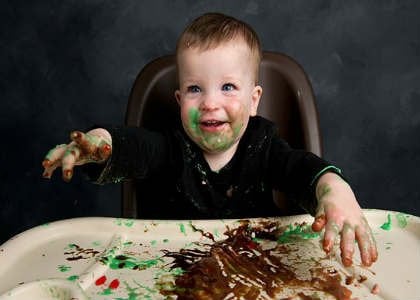
The messiest babies may be the fastest learners, according to a new study from the University of Iowa. Non-solid foods like applesauce or oatmeal can be difficult for babies to recognize because they look very different depending on if they’re in a bowl, a spoon, or a puddle. Researchers found that the babies who played with their food the most (and made the biggest mess) were the most successful at recognizing the names of gooey substances when later presented with them in different shapes or quantities. The researchers believe that being open to exploration may boost both early vocabulary and later cognitive development. Will you be more tolerant of a messy high chair after learning about the benefits of playing with your food?

Study shows toddlers learn words for nonsolids better when getting messy in a highchair.

This is a messy baby in a high chair.
Attention, parents: The messier your child gets while playing with food in the high chair, the more he or she is learning.

Researchers at the University of Iowa studied how 16-month-old children learn words for non-solid objects, from oatmeal to glue. Previous research has shown that toddlers learn more readily about solid objects because they can easily identify them due to their unchanging size and shape. But oozy, gooey, runny stuff? Not so much.

New research shows that changes if you put toddlers in a setting they know well. In those instances, word learning increases, because children at that age are “used to seeing nonsolid things in this context, when they’re eating,” says Larissa Samuelson, associate professor in psychology at the UI who has worked for years on how children learn to associate words with objects. “And, if you expose them to these things when they’re in a highchair, they do better. They’re familiar with the setting and that helps them remember and use what they already know about nonsolids.”

In a paper published in the journal Developmental Science, Samuelson and her team at the UI tested their idea by exposing 16-month-olds to 14 nonsolid objects, mostly food and drinks such as applesauce, pudding, juice, and soup. They presented the items and gave them made-up words, such as “dax” or “kiv.” A minute later, they asked the children to identify the same food in different sizes or shapes. The task required the youngsters to go beyond relying simply on shape and size and to explore what the substances were made of to make the correct identification and word choice.

Don’t let the mess in the high chair bother you. New research shows kids who get messy in the high chair are learning Credit Tim Schoon.
Not surprisingly, many children gleefully dove into this task by poking, prodding, touching, feeling, eating—and yes, throwing—the nonsolids in order to understand what they were and make the correct association with the hypothetical names. The toddlers who interacted the most with the foods—parents, interpret as you want—were more likely to correctly identify them by their texture and name them, the study determined. For example, imagine you were a 16-month-old gazing at a cup of milk and a cup of glue. How would you tell the difference by simply looking?

“It’s the material that makes many nonsolids,” Samuelson notes, “and how children name them.”
The setting matters, too, it seems. Children in a high chair were more apt to identify and name the food than those in other venues, such as seated at a table, the researchers found.
“It turns out that being in a high chair makes it more likely you’ll get messy, because kids know they can get messy there,” says Samuelson, the senior author on the paper.
The authors say the exercise shows how children’s behavior, environment (or setting), and exploration help them acquire an early vocabulary—learning that is linked to better later cognitive development and functioning.

“It may look like your child is playing in the high chair, throwing things on the ground, and they may be doing that, but they are getting information out of (those actions),”
Samuelson contends. “And, it turns out, they can use that information later. That’s what the high chair did. Playing with these foods there actually helped these children in the lab, and they learned the names better.”
“It’s not about words you know, but words you’re going to learn,” Samuelson adds.
Lynn Perry, who helped design the study and analyze the data as part of her doctoral studies at the UI, is the first author on the paper. Johanna Burdinie, who was an UI undergraduate during the project, is a contributing author.

Notes about this psychology and learning research
The National Institutes of Health (grant number: R01 HD045713) funded the research. Burdinie was funded by a fellowship from the Iowa Center for Research for Undergraduates.


Have You Ever Seen Google Data Centres No? Just See it Now

Have you ever wondered how Google does what it does? What makes it perch at the top? Well, to reveal a part of it, Google has launched a website where the visitors are offered quite amazing photos taken inside Google Data Centers in U.S., Finland and Belgium. There are a total of eight data centers in the above mentioned countries and Google is building more in Hong Kong, Taiwan, Singapore and Chile.  The virtual tour of North Carolina data centre will also be made available in the street view being offered by Google. Before you dive into the amazing pictures, take a sec to commend Google for being there for us whenever we need it, thanks a lot Google!

Take a Look – Google Data Centre
It’s not just an amazing color display folks, welcome to campus network room where the fiber optic network usually works at a speed which is 200,000 times faster than your internet connection at home. Those yellow cable trays are for the fiber cables which are running throughout and making Google achieve what others cannot.
Take a Look – Google Data Centre 2
Did you know that the Council Bluffs Data Centre has over 115,000 sq. ft. of space available? Google sure is making great use of this space to help us search and browse efficiently.

Take a Look – Google Data Centre 3

Not just intricate building folks, you are looking at the steel beams which are supporting the whole structure while also acting like a backbone when it comes to distributing power.

Churna Island - Island in Arabian Sea Near Karachi - World Tour

Churna Island - Island in Arabian Sea Near Karachi
Churna Island is a small uninhabited Pakistani island located in the Arabian Sea, about 9 km west of the mouth of the Hub river, at the boundary between the provinces of Balochistan and Sindh. Churna is approximately 1.2 km long and 0.5 km wide.

Churna is mostly used as a firing range by the Pakistan Navy.


Churna Island - Island in Arabian Sea Neak Karachi
Churna Island - Island in Arabian Sea Near Karachi

Churna Island - Island in Arabian Sea Near Karachi

Churna Island - Island in Arabian Sea Near Karachi

Churna Island - Island in Arabian Sea Near Karachi


Resham in Bridal Dress - Pantene Week

Getting glamour right in a bridal dress is definitely Aisha Imran’s cup of tea. Here’s a preview of her latest couture straight from the runaway featuring the ONE and ONLY Resham.


Orient Linen Collection, 2013 - Orient Textiles's newest collection - is now available in stores and online!

Orient Linen Collection, 2013 - Orient Textiles's newest collection - is now available in stores and online!
Orient Linen Collection 2013
 

Apple and Microsoft’s Patent Troll Sues Google Over Android

A patent troll funded by Apple, Microsoft, and a handful of other tech companies is suing Google and a number of its Android partners, including Samsung, HTC, Asustek, and LG.
Rockstar CEO John Veschi. Photo: Dan Krauss/Wired

The lawsuits were filed on Thursday by a tiny company called the Rockstar Consortium, as first reported by Reuters. Rockstar is a new breed of company. It’s jointly owned by five tech giants — Apple, Microsoft, Blackberry, Sony, and Ericsson — and it’s chartered with making back the $4.5 billion these companies pooled together to build its patent portfolio.
Rockstar was born in 2011, when Google and Intel lost a high-profile bidding war for the remains of Canadian telecom giant Nortel’s patent portfolio.
The consortium couldn’t be reached for comment, but when WIRED profiled Rockstar last year, its CEO John Veschi told us that “pretty much” all technology companies infringed his massive portfolio of over 4,000 patents. “It would be hard for me to envision that there are high-tech companies out there that don’t use some of the patents in our portfolio,” he said.
Rockstar employs a handful of former Nortel engineers who spend their days in Ottawa reverse-engineering labs scouring the tech world for infringing products.
In the lawsuits filed Thursday, Rockstar sued Google, Asustek, HTC, Huawei, LG, Pantech, Samsung and ZTE. Court documents show that the company has created two subsidiaries — Mobilestar and Netstar — presumably in order to focus its patent licensing ventures in different areas. That would be one subsidiary for mobile and one for internet technologies.

New Android Boss Finally Reveals Plans for World’s Most Popular Mobile OS

For the past few years, Sundar Pichai has been part of a tag-team routine staged at Google’s annual I/O developer conference. Pichai, a Googler since 2004, would present on behalf of Google’s Chrome division, including its browser and cloud-based operating system. His counterpart was Andy Rubin, head of Google’s Android division. As Android grew to the world’s most popular mobile OS (it’s now on 750 million devices worldwide, with 1.5 million new activations every day), people wondered what was the sense of Google having two operating systems. Meanwhile, Andy Rubin was the unofficial king of I/O.
That won’t be the case this year. In March, Google announced Rubin was stepping down from Android to pursue unspecified moon shots elsewhere in the company. Pichai would take over Rubin’s duties at Android. He immediately went from being an important Google executive (in addition to Chrome, he was also in charge of Google’s apps efforts) to perhaps the most pivotal member of Larry Page’s “L-team” of top executives. So far Pichai, a 40-year old grad of the fabled Indian Institute of Technology and later Stanford, has kept his head down and refused all press. But as this week’s I/O event approached, he granted WIRED his first interview since taking over Android.
WIRED: The Android handover from Andy Rubin to you seemed sudden and mysterious to us on the outside. Was it long in the works?
PICHAI: I got to know only towards the end of the process of Andy deciding to step back. It played out in a rapid time fashion over the couple weeks prior to the actual announcement. I am passionate about computing and so to me, it was very exciting to be in a position where I could make an impact on that scale.
Now that you’re in this new position, have your views evolved in terms of the coexistence of Chrome and Android?
I don’t think my views have changed much. Android and Chrome are both large, open platforms, growing very fast. I think that they will play a strong role, not merely exist. I see this as part of friendly innovation and choice for both users and developers.
But can’t it be confusing having two operating systems?
Users care about applications and services they use, not operating systems. Very few people will ask you, “Hey, how come MacBooks are on Mac OS-X and iPhone and iPad are on iOS? Why is this?” They think of Apple as iTunes, iCloud, iPhoto. Developers are people, too. They want to write applications one time, but they also want choice. What excites me in this new role is that I can try do the right thing for users and developers — without worrying about the fact that we have two things. We embrace both and we are continuing to invest in both. So in the short run, nothing changes. In the long run, computing itself will dictate the changes. We’re living through a pivotal moment. It’s a world of multiple screens, smart displays, with tons of low-cost computing, with big sensors built into devices. At Google we ask how to bring together something seamless and beautiful and intuitive across all these screens. The picture may look different a year or two from from now, but in the short term, we have Android and we have Chrome, and we are not changing course.
Still, it’s a huge use of resources to have two operating systems as opposed to one. This has to be an issue you wrestle with.
It’s a fair question. We want to do the right things at each stage, for users and developers. We are trying to find commonalities. On the browser layer, we share a lot of stuff. We will increasingly do more things like that. And maybe there’s a more synergistic answer down the line.
As Android’s new head, what do you see as the biggest challenge?
First let me talk about the opportunities. The scale and scope is even bigger than what I had internalized. The momentum — in terms of new phones and new tablets — is breathtaking. I see huge opportunity, because it is just shocking how much of the world doesn’t have access to computing. In his book Eric [Schmidt] talks about the next 5 billion [the people on earth who aren’t connected to the internet who soon will be]. That’s genuinely true and it excites me. One of the great things about an open system like Android is it addresses all ends of the spectrum. Getting great low-cost computing devices at scale to the developing world is especially meaningful to me.

Will Salman Khan and Katrina Kaif reunite?


Ex-flames, Salman Khan and Katrina Kaif have recently been in the headlines for their respective love-lives. Lately, rumors have been doing rounds that Sallu and Kat will be shaking a leg in Salman’s brother-in-law, Atul Agnihotri’s film O Teri.

Salman and Kat were last seen in Ek Tha Tiger. The duo have also done an item number in Atul Agnihotri’s Bodyguard. So, will these ex-lovers reunite for yet another item number with Atul Agnihotri?

Atul says, “It’s too early right now as we are still working on the song track. We have not approached Katrina, but Salman has been involved with the project right from the beginning. Katrina has always been with us. She is our well-wisher and a wonderful person, so let’s see how things shape up. In Bodyguard, both of them looked good and it worked.” Hmmm… No smoke without fire, right? Also, is he trying to suggest that Sallu-Kat don’t look good together anymore? Or is it because of some Mr. RK in Kaif’s life that we won’t get to see these ex-flames together on the big screen…

Apart from Atul Agnihotri’s comment, we’ve other reasons too why we think it’s doubtful that we will get to see Salman-Kat together again. Firstly, this year Kat was not invited for Sallu’s Iftar party. What more (we wonder if it was an act of vengeance), Salman Khan wasn’t a part of the guest list of Katrina’s sister’s wedding.

Well, with this changing equation between the two, we aren’t surprised that Atul is having second thoughts of casting the two together. What if, instead of delivering a sizzling chemistry, the duo end up delivering cold vibes?

BollyWood Actress Deepika Padukone, Keen to work with Salman Khan


 Deepika Padukone, Keen to work with Salman Khan
 Deepika Padukone, Keen to work with Salman KhanAdd caption


Keen to work with Salman Khan, says Deepika Padukone

  Actress Deepika Padukone says she is keen to work with superstar Salman Khan but is waiting for something special to bring them together on screen.

Deepika had an acting debut offer from Salman, which happened way before she was chosen by Farah Khan for Om Shanti Om. However, she declined it then as she felt she was not ready to face the camera.

"He offered me my first film when I was too young and I was not ready to be in front of the camera. I will always be grateful to him. Just the fact that he offered me a film was a great thing. It is taking a long time for us to come together on screen, so I think there is something special waiting for us," Deepika said last night.

The actress, who will be seen alongside south superstar Rajnikanth for the first time in Kochadaiyaan, says she admires his child like enthusiasm.

"I worked for three days with him. I took back from him is his simplicity, humility and child like attitude on sets. Despite achieving so much success he is so excited, enthusiastic and energetic even today, this is something that is inspiring to see," she said.

A lot of appreciation is coming Deepika's way with the success of films like 'Chennai Express', 'Yeh Jawani Hai Deewani', 'Race 2' but the actress feels awkward when people compliment her.

"I feel lucky enough to play special characters with good actors and directors...I feel awkward when people compliment me. I don't take compliments well, I don't reciprocate well," the actress said.

Deepika is happy to be a part of Sanjay Leela Bhansali's romantic drama 'Ram Leela' opposite Ranveer Singh.

"There are various ways of telling a love story, like he (Sanjay) did with 'Hum Dil De Chuke Sanam', 'Devdas', and now he has come with a new love story 'Ram Leela', with a new background, new palette. Gujarat is not explored much in films, it is a new, different side of Gujarat," she said.

"The exciting part is that the film is new looking, fresh and different, it is a risk that we both (Ranveer and I) have taken... It is a new take on love story. We are nervous but excited," she said.

Deepika said it was not easy as it was emotionally, mentally and physically demanding film.